This Is No Longer a Tech Blog⚓︎
Last week, in a conversation with friends, we brought up some conversations about this "tech blog". I tried to explain my original intention of this blog:
- The best way to learn is to teach. I am used to imagine I am preparing a lecture to teach my students. Thus, I need to try to explain the knowledge in a clear and organized way. And if there is a chance to teach, I will be confident to share my blog with my students as a good reference.
- The palest ink is better than the best memory. The knowledge system will help me to quickly recall the knowledge I have learned, like a dictionary. Or, lazy me treats this blog as my second brain.
- Confucius said: "I reflect on myself three times a day." In the era of AI explosion, keep learning and reflecting is the only way to keep up with the fast changing world. This blog is the best inspiration Dojo to polish my mind and keep me thinking.
- Open source is the best way to share knowledge. As a developer, engineer, or human, I hope my blog can help more people to learn and grow together. I would love to contribute to the human knowledge system and make the world a better place.
However, even though with above bullets, I still feel like I am not fully satisfied how to introduce my blog the best and most effective way.
Digital Garden? No⚓︎
The idea of the blog was inspired by the digital garden. Compared the traditional timeline based blog, the digital garden allows for a more interconnected and evolving representation of knowledge.
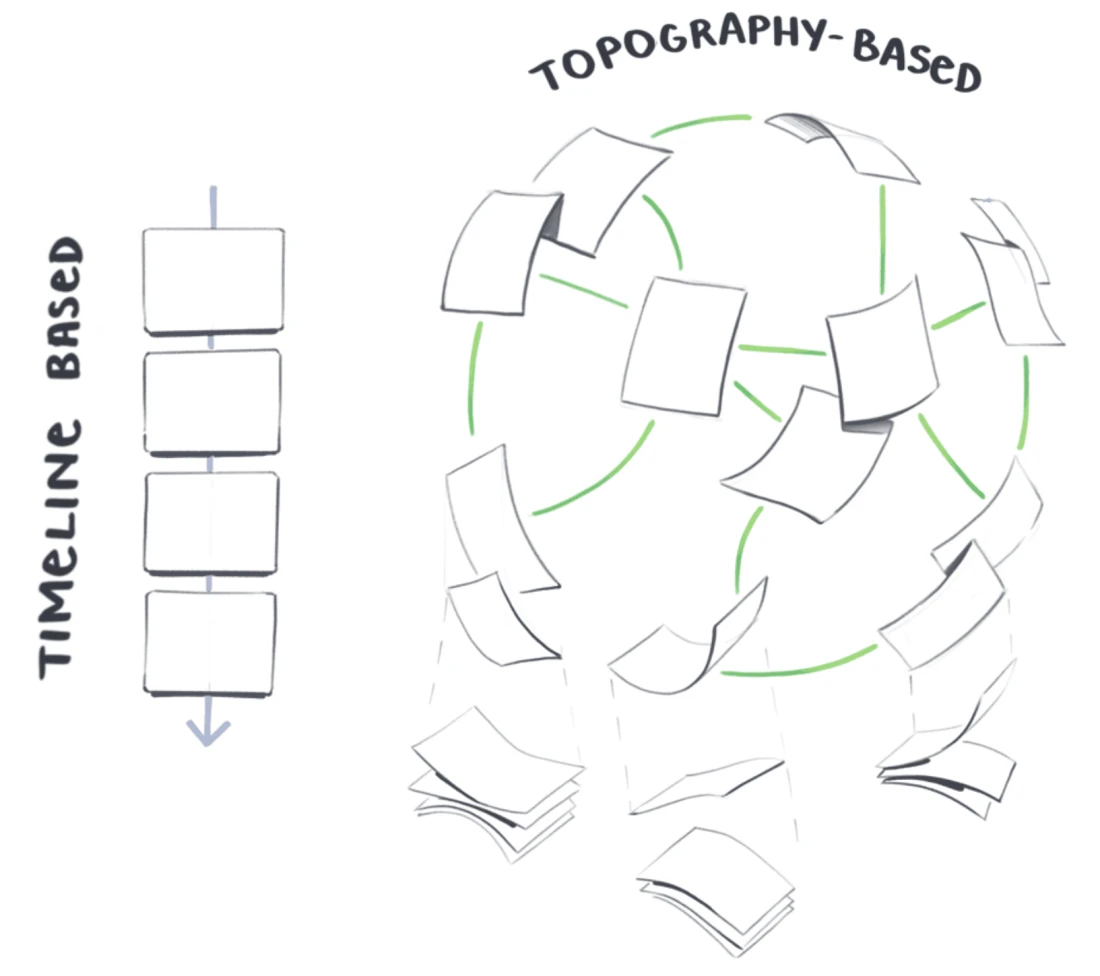
My blog builds a little bit differently from the typical digital garden. Here is how I discribe in the repo's README.md:
README.md
"I wanted to organize my knowledge in a non-traditional way, not as a linear or purely sequential system.. The concept of Digital Garden inspired me a lot. I wanted to plant the seeds of knowledge but I want to grow a tree instead of a scattered garden of disconnected notes. I prefer organizing knowledge by concepts rather than by subjects.
Here are my blog principles:
- writing like teaching - the best way to review notes is output it well.
- fast knowledge preservation with scalability and indexing.
- long-term knowledge system but always beginner friendly.
- blogging existence to encourage endless knowledge pursuing.
Overall, it is my personal second brain."
Suzhou Classical Gardens⚓︎
By reviewing the above principles in mind, The Classical Gardens of Suzhou comes to my mind.
The Suzhou Classical Gardens is a world heritage site in China. The gardens are designed to be a microcosm of nature, with carefully arranged rocks, water features, and plants. The gardens are also designed to be a place of contemplation and reflection, with winding paths and hidden corners that encourage visitors to slow down and appreciate the beauty of the natural world. In Chinese: “虽由人作,宛自天开。”
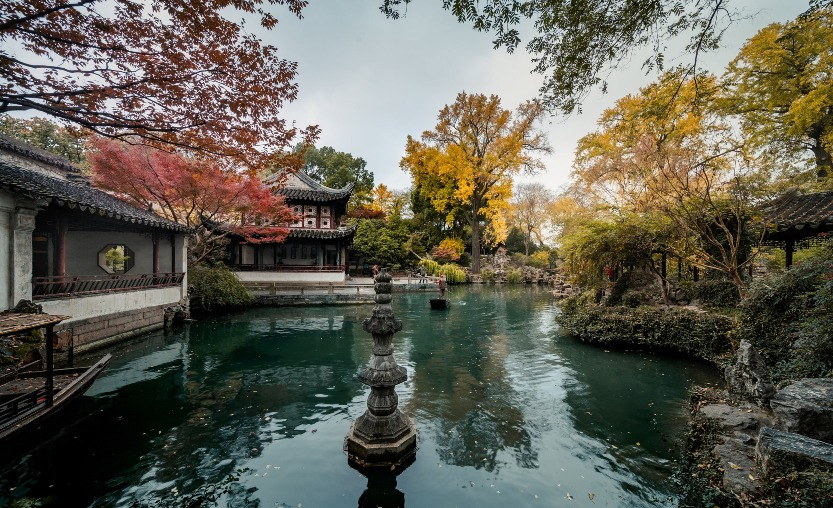
To conclude this type of garden, Scholars’ Garden is the best description.
The Scholar’s Garden⚓︎
Renaming the tech blog with The Scholar’s Garden matches the philosophy of my knowledge theory behind it. The Scholar reflects the cultivation of knowledge, and the Garden reflects the nature of the knowledge system.
Talking about the world Scholar, by coincidance, I have a personal motto for more than 15 years: "When all else pales, the pursuit of knowledge soars". It was from a poet named Zhu Wang (汪洙) in the Song (宋) Dynasty. The original Chinese is: "万事皆虚,惟学不灭". It was also the poem my grandfather taught me when I was a child. There is another translation on this scentence, which is "To be a scholar is to be the top" (万般皆下品,惟有读书高).
Second Brain⚓︎
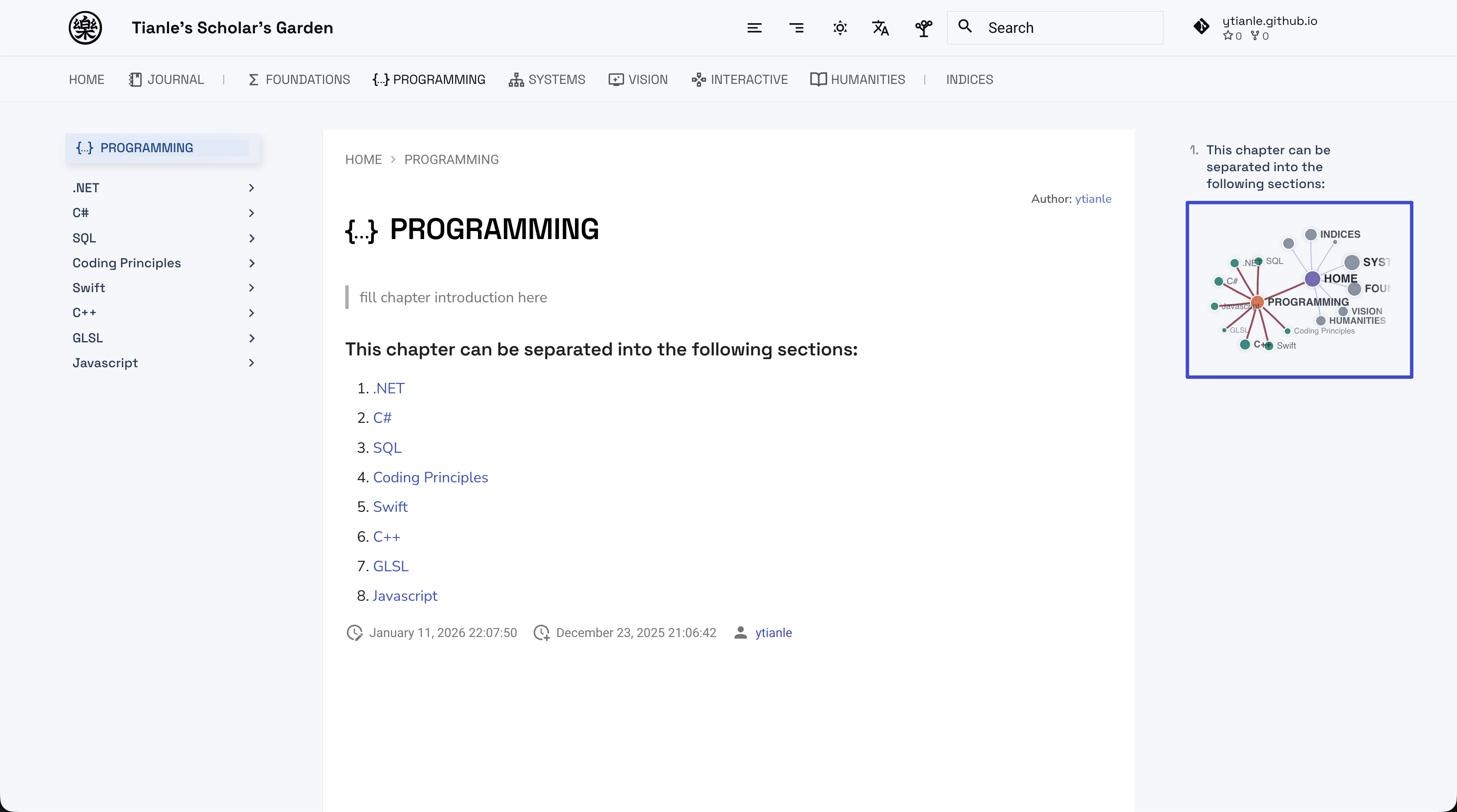
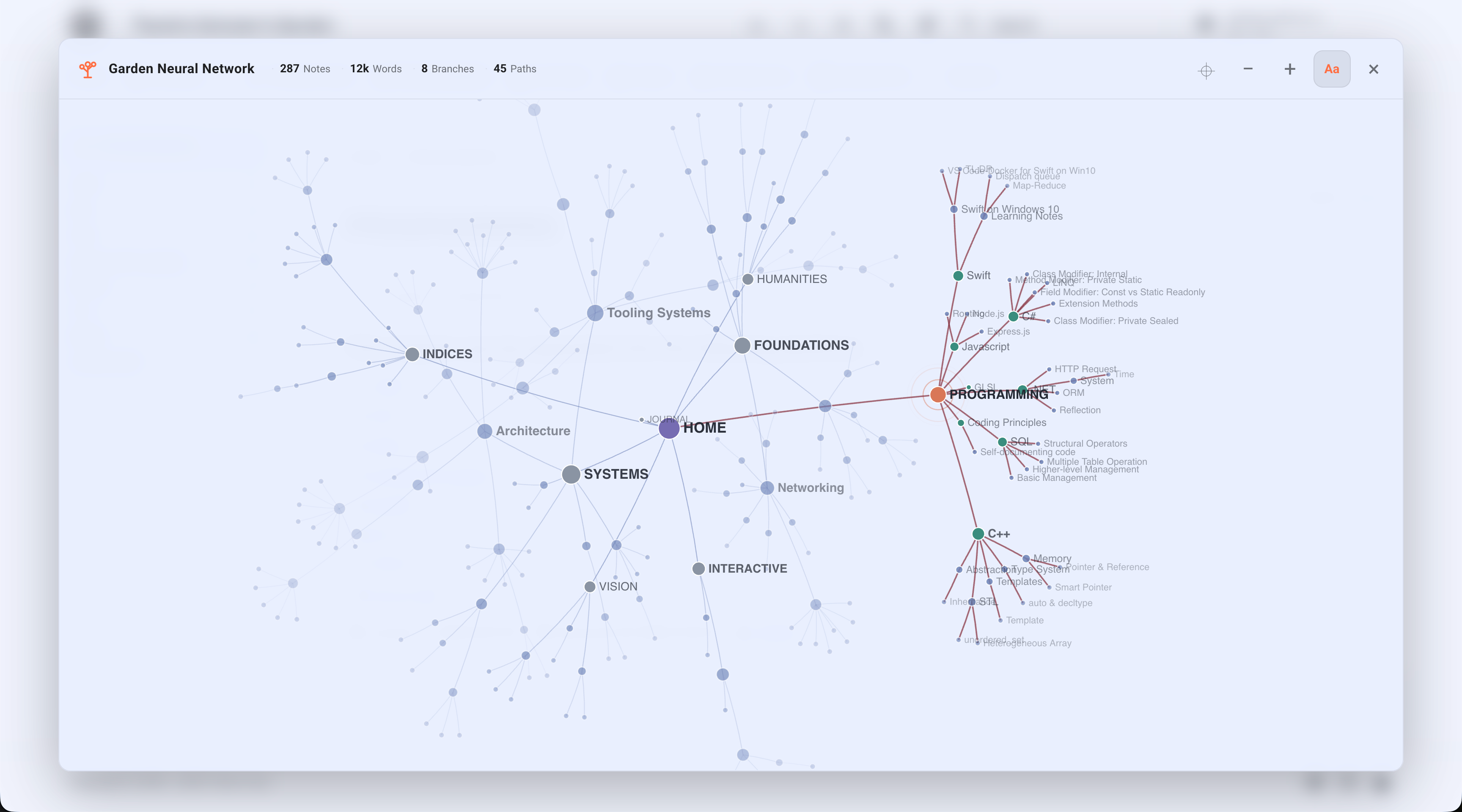
To clearly show up my cultivation of knowledge system, I adopt the concept of a second brain, which is constructed by connected neurons. To visualize my second brain, I added an interactive Garden Neural Network based on the Interactive Graph plugin for Material for MkDocs that represents the connections and relationships between different pieces of knowledge. The rendered graph tracks the growth and evolution of my knowledge over time and also help readers anchor where they are in the knowledge system. Here is an example of my Garden Neural Network: